


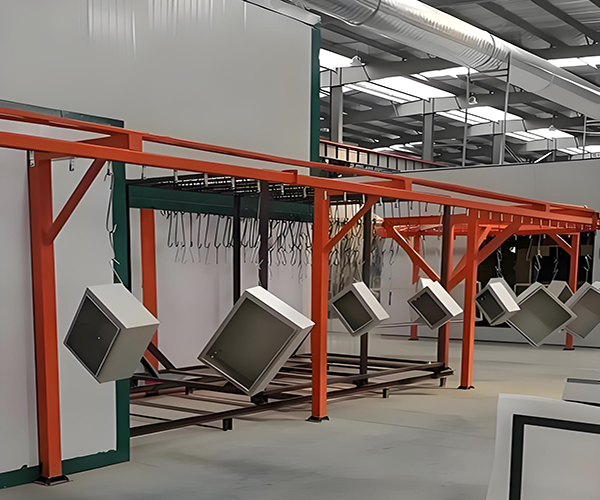
As the manufacturing industry moves towards high-end manufacturing, powder coating lines, with their high efficiency, precision, and environmentally friendly characteristics, have become core equipment in the metal surface treatment field. From rail transit vehicles to precision electronic devices, from architectural decorative profiles to new energy equipment, this modern production line, comprised of automated equipment and intelligent systems, is reshaping the technological boundaries of industrial coating.
I. The Essence of the Technology: Precision Sculpture in an Electrostatic Field
The core of the powder coating process lies in the synergistic effect of electrostatic adsorption and powder melting. A high-voltage electrostatic field induces directional movement of negatively charged powder particles, creating a uniform powder layer structure on the workpiece surface. This non-contact coating method overcomes the physical limitations of traditional spray painting, enabling comprehensive coverage of workpieces with complex geometries and is particularly suitable for filling microscopic defects on the surface of castings.
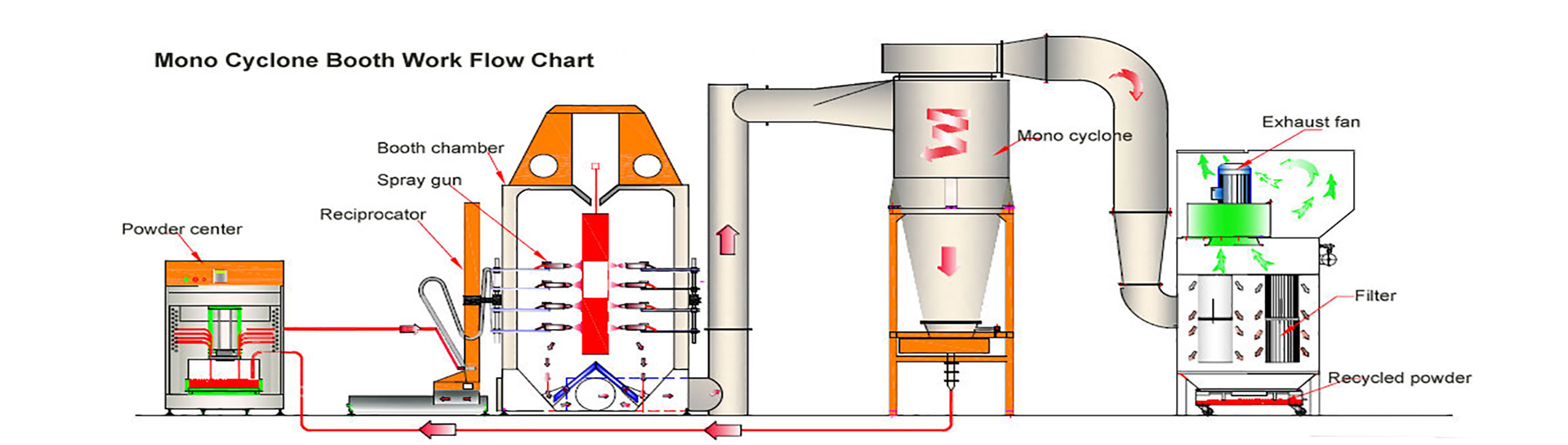
Modern spray systems use ionized air removal technology to eliminate the problem of grainy coatings caused by powder agglomeration. The intelligent powder supply center, equipped with a closed-loop pressure control system, automatically adjusts the powder output according to the workpiece shape, maintaining consistent coating thickness in curved transition areas. The recovery system utilizes a multi-stage filtration design, achieving industry-leading powder utilization and significantly reducing material consumption.
II. Process Innovation: Four-Dimensional Quality Control
Surface Activation: Molecular-Level Pretreatment
Pretreatment involves creating a microscopic roughness structure on the metal surface through nano-sandblasting or chemical conversion coating technology. This treatment not only enhances coating adhesion but also forms a dense anti-corrosion barrier. A novel chromium-free passivation process creates a molecular-thick conversion coating on aluminum surfaces, improving salt spray resistance several times.
Electrostatic Deposition: Submicron Precision
The intelligent spray gun features a built-in dynamic compensation algorithm that corrects for uneven electric field distribution in real time. A multi-axis robot equipped with a vision positioning system can automatically identify workpiece features, ensuring uniform coating on complex structural parts. An aviation parts production line has achieved extremely high edge coating coverage by optimizing spray gun trajectories.
Hot-melt curing: Precise control of the phase change process
Combined heating technology using infrared radiation and hot air circulation enables the coating to complete its glass transition in a short period of time. An intelligent temperature control system, using a distributed sensor network, minimizes temperature fluctuations in the curing chamber, preventing cracking caused by thermal stress.
Online inspection: Millisecond-level defect detection
A machine vision system combined with a deep learning algorithm enables coating appearance inspection within production cycles. A new inspection device uses multispectral imaging technology to penetrate the coating and identify cracks in the substrate, achieving micron-level detection sensitivity.
III. Industry Applications: From Standardization to Customization
Automotive Manufacturing: Lightweight Coating Solutions
New energy vehicle bodies utilize low-temperature curing powder coatings, reducing energy consumption while meeting corrosion protection requirements. A modular production line enables the simultaneous production of multiple models, significantly reducing color changeover time. The use of automatic masking devices enables localized enhanced coating of complex structural components.
Architectural Sector: Super Weather-Resistant Solutions
Fluorocarbon powder coatings developed for extreme environments maintain excellent performance even after artificial accelerated aging tests. The automatic color change system equipped in the spray coating line allows for rapid adjustment of coating color and gloss to meet the personalized needs of building curtain walls.
3C Electronics: Micron-Level Precision Coating
The laptop casing production line utilizes nano-scale powder coatings, achieving ultra-thin coatings through electrostatic atomization technology. The integration of a plasma cleaning module significantly enhances the bond strength between the coating and the anodized substrate, meeting the stringent requirements of consumer electronics.
IV. Intelligent Evolution: The Nerve Center of the Digital Factory
Digital Twin Technology
A virtual simulation system simulates the powder deposition process and optimizes spray gun trajectory parameters. Real-time data mapping allows production managers to monitor equipment status in a digital space and proactively identify potential failures. A pilot project significantly reduced material waste through process simulation.
AI Quality Prediction
A deep learning model based on historical production data can predict the probability of coating defects. By analyzing environmental parameters, equipment status, and process variables, the system proactively adjusts production parameters, significantly improving first-pass yields.
Modular Architecture
The new spray unit utilizes standardized interfaces, allowing for flexible configuration based on production capacity needs. A startup, by leasing basic modules, quickly established a scalable coating production line, significantly reducing initial investment costs.
V. Green Transformation: From End-of-Pipe Treatment to Source Reduction
Powder Closed-Loop System
Supersonic airflow pulverization technology ensures recycled powder performance approaches that of virgin material. Intelligent sorting equipment automatically adjusts powder formulations based on particle size distribution, ensuring consistent coating quality. One company has significantly reduced hazardous waste generation annually through powder recycling.
Near-Zero VOC Emissions
The combined application of condensation recovery and catalytic combustion technologies significantly improves exhaust gas treatment efficiency. By optimizing the airflow distribution within the spray booth, one production line has minimized powder emissions, significantly improving the working environment.
Comprehensive Energy Utilization
The curing furnace waste heat recovery system converts waste gas heat into hot water for pretreatment, forming a cascaded energy utilization network. Through heat recovery retrofits, a factory has significantly reduced its overall energy consumption and achieved industry-leading carbon emissions.
In this technological revolution in surface treatment, the plastic spraying line has evolved into a complex system integrating materials science, automated control, and artificial intelligence. With 5G technology enabling millisecond-level communication between devices, blockchain ensuring the immutability of process data, and the deep integration of additive manufacturing and plastic spraying, a new era of industrial coating is dawning. On this perpetually moving assembly line, every flying powder particle is writing a new chapter in the high-quality development of the manufacturing industry.