


Take the spraying of car wheels, for example. Traditional processes previously required multiple spraying cycles to completely cover the concave areas around the wheel. Now, with electrostatic spraying equipment, by adjusting the electric field strength, the powder easily penetrates the gaps in the wheel, forming a uniform coating. This not only reduces the processing time per piece, but also minimizes variations in coating thickness. II. Equipment Configuration: The "Tactful Cooperation" of Various Components
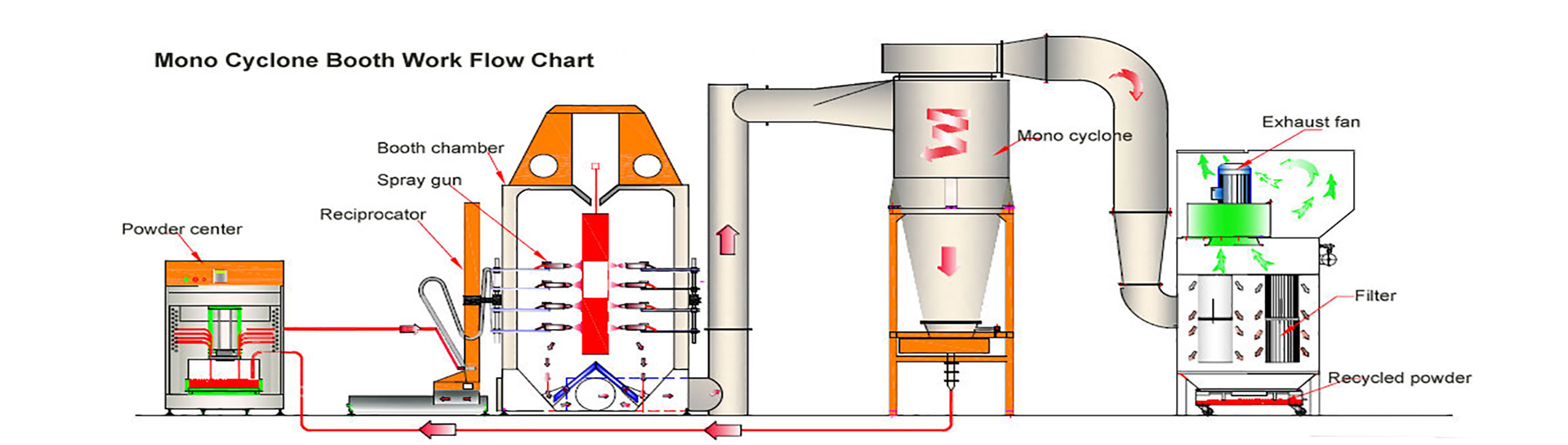
A complete electrostatic spraying system consists of several core modules, each with its own important function:
The spray gun system: This is the equipment's "executive powerhouse." The spray gun houses a high-voltage generator and atomizer. During operation, compressed air draws the powder coating into the gun body, where it is charged by a high-voltage electric field. The powder is then sprayed out through a specially designed nozzle as a uniform cloud of mist. Some high-end spray guns utilize rotating atomizer technology, which produces finer powder particles and a smoother coating surface.
The powder supply system: This serves as the equipment's "powder delivery pipeline." There are two types of powder supply systems: a hopper type and a vibrating screen type. The hopper type uses a Venturi pump to generate negative pressure to draw in powder and is suitable for small-batch production. The vibrating screen type uses mechanical vibration to fluidize the powder, providing more stable delivery and is commonly used in automated production lines. Modern equipment is also equipped with an intelligent powder supply module that monitors the remaining powder level in real time and automatically replenishes it when it runs out, eliminating the need for workers to constantly monitor the machine and preventing downtime.
Control System: This is the "brain" of the equipment. The controller uses digital circuits to adjust parameters such as voltage, current, and powder delivery. For example, when spraying an oddly shaped workpiece, the operator can adjust the electric field distribution via the touchscreen to ensure even coverage of the powder. Some equipment also incorporates AI algorithms that automatically plan the spraying route based on the workpiece's shape, reducing manual operation.
Recovery System: This system utilizes a combination of a cyclone separator and filter element to recover powder that has not adhered to the workpiece for recycling. This dual-stage recovery system achieves a high powder recovery rate, significantly reducing material costs and dust emissions, meeting environmental standards. III. Application Areas: A "Painting Expert" in Various Industries
Electrostatic spraying equipment is highly adaptable and can be used in nearly all industrial sectors requiring surface protection or decoration:
Automobile Manufacturing: Electrostatic technology is most commonly used for the spraying of components such as vehicle body panels, bumpers, and wheels. After implementing electrostatic spraying, one automobile factory reduced paint consumption per vehicle, prolonged the coating's resistance to salt spray corrosion, and improved the product's market competitiveness.
Home Appliance Industry: The spraying of the exteriors of appliances such as refrigerators, washing machines, and air conditioners demands a high level of aesthetics. Electrostatic spraying equipment can achieve a variety of surface effects, including metallic, matte, and high-gloss finishes. The coating also has strong adhesion, preventing it from fading even with frequent opening and closing of doors or handling.
Architectural Decoration: The spraying of building materials such as aluminum alloy doors and windows and curtain wall panels requires both corrosion protection and aesthetics. Electrostatic technology allows the powder to penetrate the complex cavities of metal profiles, creating a seamless coating and significantly extending the service life of the building materials. Electronic equipment: Server cabinets, 5G base station housings, and other electronic equipment require particularly stringent coating uniformity and weather resistance. Electrostatic spraying equipment can precisely control coating thickness, preventing electromagnetic shielding failure and meeting the demands of long-term outdoor use.
IV. Future Trends: Becoming Smarter and More Environmentally Friendly
With the advancement of Industry 4.0 and the "Dual Carbon" goals, electrostatic spraying equipment is also upgrading in two directions:
Smarter: Equipment will be deeply integrated with robotics to achieve unmanned spraying. One R&D institution has already launched an electrostatic spraying robot equipped with a 3D vision system. It can automatically identify the workpiece model and adjust the spraying strategy, making it several times more efficient than manual operation.
More Environmentally Friendly: To adapt to the trend towards low-VOC coatings, equipment manufacturers are improving spray gun structure and power systems, enabling the use of environmentally friendly materials such as water-based and high-solids coatings. Furthermore, by optimizing recovery systems, powder emissions are kept to a very low concentration, helping companies achieve "zero-pollution" production. From its introduction to China in the 1980s to its current status as a standard feature of industrial coatings, electrostatic spraying technology has proven its value over decades. It represents not only a revolution in efficiency but also a key enabler for the manufacturing industry's transition toward high-quality, sustainable development. In the future, with advances in materials science and automation technology, electrostatic spraying equipment will undoubtedly unlock even more application scenarios, bringing new vitality to industrial production.