


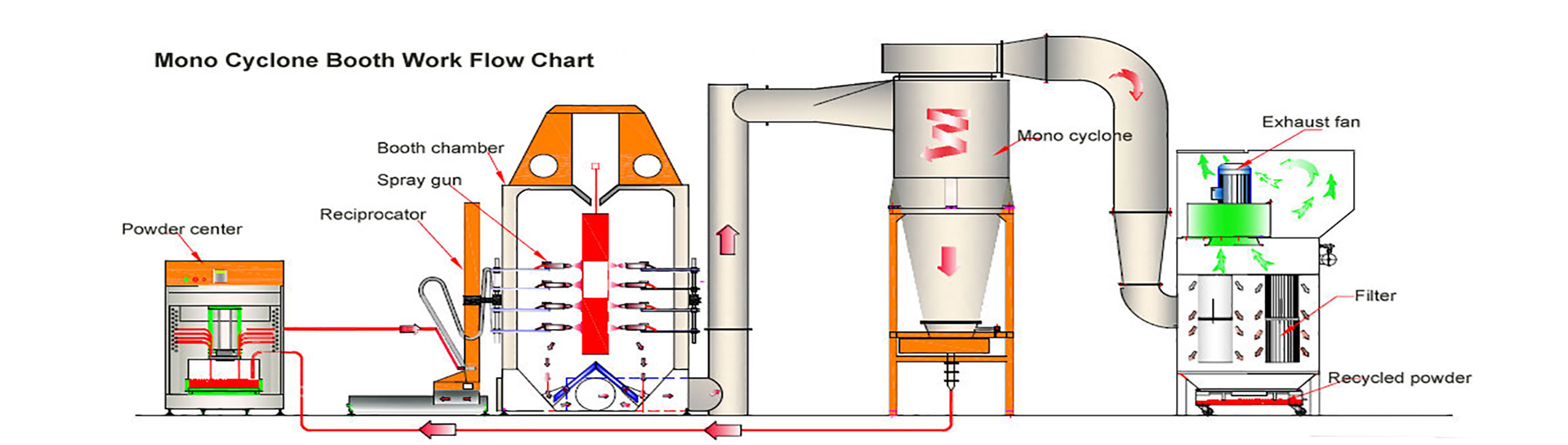
Behind the glossy finish of car bodies, the soft matte finish of household appliances, and the anti-rust coating of mechanical parts, a "revolution in appearance level" driven by spray painting assembly lines is reshaping the competitive landscape of the manufacturing industry. As consumers' demands for product appearance keep rising, the spray painting assembly line is no longer merely a simple "painting process", but a crucial link that determines whether an enterprise can gain a firm foothold in the market.
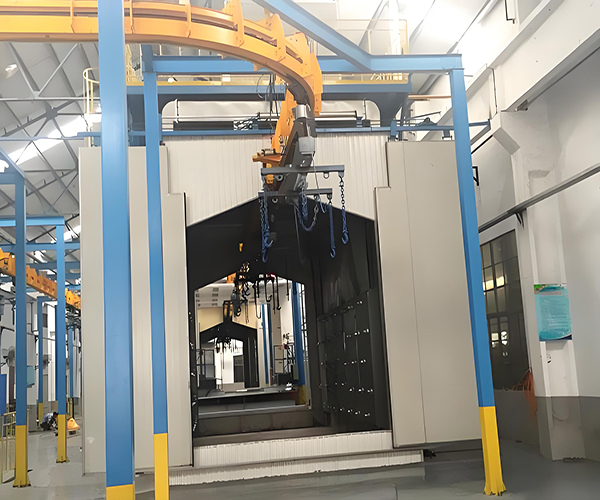
I. Efficiency Code: The Transformation from "Manual Jogging" to "Mechanical Speeding"
In the past, in the spray painting workshop, workers held spray guns and shuttled back and forth in the thick paint mist. Each product had to go through a intermittent process of waiting, spraying, drying and inspection. This mode of operation is not only inefficient but also prone to quality fluctuations due to human fatigue. Nowadays, the intelligent spray painting assembly line has completely changed this situation.
Take a certain auto parts enterprise as an example. After introducing a customized painting assembly line, the production cycle was significantly shortened. In the past, it took 72 hours from the product entering the factory to the completion of painting, but now it has been shortened to about 50 hours. The robotic arms, intelligent conveyor belts and closed-loop control systems on the assembly line work closely together, like an efficient "industrial artery", rapidly transporting products to various workstations at a speed of 3 meters per minute.
The secret to improving efficiency lies in the optimization of processes and the integration of technologies
Parallel operation mode: Traditionally, spray painting was carried out in a serial manner, one after another. Now, multi-station parallel operation is adopted, with spraying, drying, inspection and other processes carried out simultaneously. For instance, the spray painting production line of a certain enterprise in Luoyang adopts a U-shaped layout, shortening the product flow path by nearly half. Coupled with a quick mold changing device, the production line switch can be completed within 10 minutes, significantly reducing the idle time of the equipment.
Intelligent path planning: In the past, the movement path of the spray gun relied on workers' experience. Now, through digital twin technology, the spraying process can be rehearsed in a virtual space to optimize the path in advance. By using this method, a certain home appliance enterprise has reduced the movement distance of the spray gun by a quarter and increased the utilization rate of the coating to nearly 90%.
Real-time dynamic adjustment: The Internet of Things (iot) devices on the assembly line can collect data such as temperature, humidity, and spraying pressure in real time. The system automatically adjusts parameters based on these data. After a certain mechanical manufacturing enterprise introduced this system, the overall efficiency of its equipment increased from 68% to 89%, making production more stable and efficient.
Ii. Quality Code: An Upgrade from "Relying on Experience" to "Precise Control"
In the painting workshop of a certain new energy vehicle factory, mechanical arms are performing spraying tasks with extremely high precision, and the fluctuation of coating thickness is controlled within an extremely small range, equivalent to a few tens of the diameter of a human hair. This precise control makes the product appearance more uniform and beautiful, and also greatly enhances its durability.
Behind the quality improvement lies the coordinated efforts of the three major technical systems:
The popularization of new environmentally friendly materials such as water-based coatings and powder coatings not only reduces the emission of volatile organic compounds (VOCs), but also enhances the performance of coatings through improved formulas. For instance, the nano-ceramic coating developed by a certain coating enterprise has significantly enhanced the hardness of the coating, greatly improved its wear resistance, and prolonged the service life of the product.
Precision spraying technology: The six-axis robot is equipped with a force feedback sensor, which can sense the spraying pressure in real time and automatically correct the spraying trajectory. High-pressure electrostatic spraying technology enables the coating to adhere more evenly to the product surface, significantly increasing the utilization rate and greatly reducing the over-spraying phenomenon. The intelligent vision system is like "sharp eyes", capable of quickly identifying defects such as pinholes and orange peel on the coating surface and automatically triggering rework instructions.
Strict environmental control: The coating quality has extremely high requirements for the environment. In the dust-free workshop of a certain high-end equipment manufacturing enterprise, the temperature fluctuation is controlled within an extremely small range, and the humidity fluctuation is also strictly limited. Combined with a micro-positive pressure system, the concentration of dust particles reaches a high standard, completely eliminating coating defects caused by environmental factors.
The digital upgrade of quality control has also played a significant role. A certain home appliance giant has established a coating quality database and accumulated a large number of process parameter combinations. Through machine learning algorithms, the system can automatically generate the optimal spraying plan, and the first-time pass rate has increased from 92% to over 98%, greatly reducing rework and waste.
Iii. Future Vision: The Evolution from "Assembly Line" to "Intelligent Manufacturing Ecosystem"
With the deep integration of technologies such as 5G, AI, and digital twins, the spray painting assembly line is breaking through physical boundaries and evolving towards a smart manufacturing ecosystem where the virtual and the real coexist.
Predictive maintenance: A vibration analysis system developed by a certain coating equipment manufacturer can detect abnormal vibrations of the spray gun motor in advance, predict the time of failure, significantly reduce unplanned downtime, and ensure production continuity.
Flexible production: The modular design enables the production line to quickly adapt to the spraying requirements of different products. A certain enterprise has been able to complete the production line switch from car bumpers to home appliance shells within two hours through rapid model change technology, significantly enhancing the equipment utilization rate.
Closed-loop optimization: The painting line of a certain automotive factory generates a large amount of data every day. Through big data analysis, the system can independently optimize process parameters, making the coating more weather-resistant and enabling the products to better adapt to different environments.
In this "revolution of appearance level", the spray painting assembly line has evolved into a complex system integrating materials science, precision manufacturing and digital technology. When a certain enterprise keeps the defect rate of its coating at an extremely low level, the premium capacity of its products significantly improves. This fully demonstrates that in manufacturing competition, even minor improvements in efficiency and quality can be transformed into significant market advantages. From nano-scale coating control to global process optimization, the spray painting assembly line is reshaping our perception of industrial aesthetics with invisible precision.