


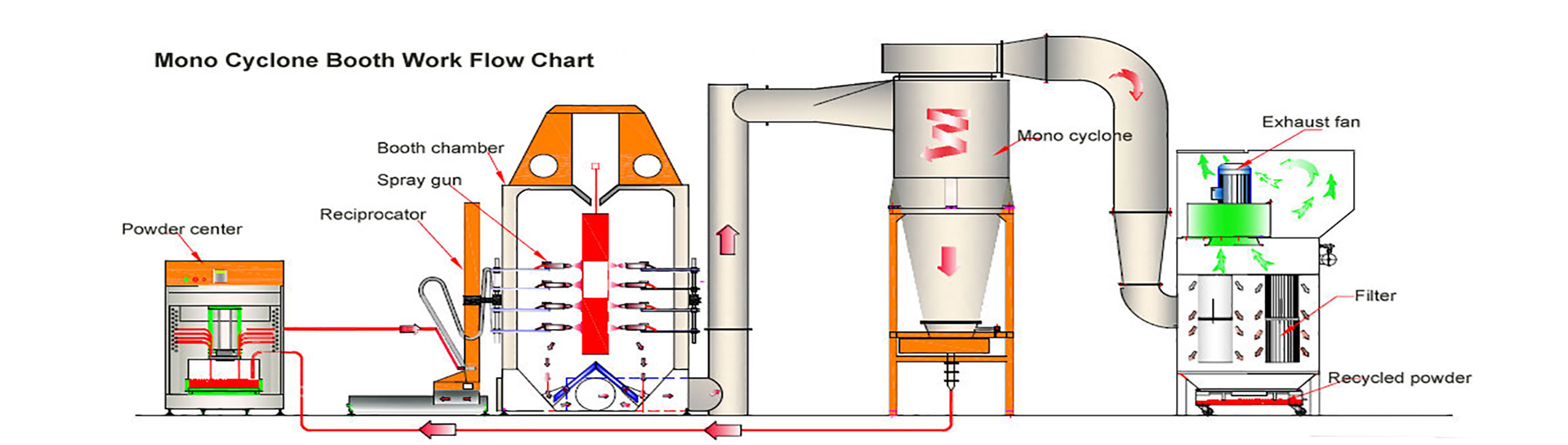
As the core equipment for surface treatment in modern manufacturing, the stable operation of spray coating assembly line directly affects the production capacity and product quality of enterprises. However, in actual production, factors such as equipment failures, process defects, material issues, environmental interference, and improper operational management often lead to decreased efficiency or substandard quality. This article combines industry cases and technical literature to systematically sort out common problems and solutions of spray painting assembly lines.
1、 Equipment malfunction related issues
1. Blocked spray gun or uneven powder discharge
Phenomenon: Decreased powder output from the spray gun, poor powder atomization, resulting in uneven coating thickness or flow marks.
Reason:
Nozzle wear (the lifespan of imported PTFE nozzles is about one month).
The aging of the Venturi tube or poor material of the powder conveying tube makes it easy for powder to adhere to the tube wall.
The powder conveying pipe is heated and clumped (such as in high temperature environments in summer).
Solution:
Regularly replace nozzles: Check and replace domestically produced PTFE nozzles every 15 days, and the lifespan of imported nozzles can be extended to 1 month.
Optimize the powder conveying system: use high-quality powder conveying pipes, install air conditioning in the spraying room to control the temperature (≤ 30 ℃), and avoid powder agglomeration.
Pre treatment of air spraying: Before formal spraying, air spray for 3-5 minutes to stabilize the powder before production.
2. Unstable curing furnace temperature
Phenomenon: Incomplete curing of the coating (sticky surface) or over baking (brittle coating).
Reason:
Thermocouple failure or aging of heating elements can cause a deviation of up to 10 ℃ between the actual furnace temperature and the displayed value.
The insulation performance of the furnace body decreases, and the hot air circulation is uneven.
Solution:
Calibrate temperature sensor: Use a furnace temperature tracker to calibrate every quarter to ensure that the actual furnace temperature is consistent with the set value.
Upgrade insulation material: use rock wool or aluminum silicate fiber insulation layer to reduce heat loss.
Optimize hot air circulation: Install deflectors to ensure even distribution of hot air and avoid local overheating.
3. The conveyor chain is stuck or the speed is uneven
Phenomenon: Workpiece transportation pauses, chain speed fluctuations, resulting in uneven spraying or insufficient curing time.
Reason:
Chain wear or drive motor malfunction.
Track deformation or insufficient lubrication.
Solution:
Preventive maintenance: Check the tension of the chain every month, replace worn chains, and lubricate the track regularly.
Variable frequency control: Install a frequency converter to adjust the motor speed and ensure stable chain speed (such as 3.3 meters per minute).
Track calibration: Use a laser calibrator to adjust the straightness of the track and avoid lagging.
2、 Process defect related issues
1. Uneven coating thickness or poor flatness
Phenomenon: Orange peel, pinholes, or sagging appear on the surface of the coating.
Reason:
Improper voltage of the spray gun (too high causing powder rebound, too low resulting in insufficient adhesion).
The spraying speed does not match the chain speed.
Uneven distribution of powder particle size (such as excessive large particles).
Solution:
Adjust spraying parameters: voltage control is between 60-80kV, and the distance between the spray gun and the workpiece is 150-200mm.
Screening powder: Use powder with a particle size of 10-50 μ m and add leveling agent to improve flowability.
Rotating spraying technology: Multi axis spraying is used for complex workpieces to ensure uniform coverage.
2. Incomplete curing or over baking
Phenomenon: Poor adhesion of the coating, insufficient corrosion resistance, or discoloration.
Reason:
Inaccurate control of curing time/temperature (such as actual furnace temperature exceeding the set value).
The thickness of the workpiece material does not match the chain speed.
Solution:
Furnace temperature tracking and monitoring: Use a data logger to monitor the furnace temperature curve in real time, ensuring that the curing time is ≥ 10 minutes (such as 180 ℃ x 20 minutes).
Optimize chain speed: Adjust the chain speed according to the thickness of the workpiece (such as reducing the chain speed to 2.5 meters/minute for thick plates).
3. Coating defects (orange peel, pinholes, bubbles)
Phenomenon: The coating surface is rough, with holes or bubbles.
Reason:
Poor powder flowability or moisture content.
Incomplete pre-treatment of the workpiece (such as poor quality of phosphating film).
The environmental humidity is too high (>80%).
Solution:
Powder pretreatment: Seal and store after opening the can, add oil repellent and defoamer.
Strengthening pre-treatment: The thickness of the phosphating film is controlled at 2-3g/m2, and the pH value of the washing tank is regularly checked.
Environmental control: Install dehumidification equipment to maintain workshop humidity ≤ 80%.
3、 Material related issues
1. Low powder recovery rate
Phenomenon: Serious powder waste, recycling system efficiency<90%.
Reason:
Filter blockage or poor cyclone separation effect.
Improper air volume control (such as fixed air volume that cannot adapt to different workpieces).
Solution:
Automatic cleaning of filter element: Install a pulse blowback device and regularly check the permeability of the filter element (replace it if the air flow rate is less than 5m/s).
Variable frequency recycling system: Adjust the air volume according to the size of the workpiece (such as increasing the air volume to 3000m3/h for large workpieces).
2. Unstable powder quality
Phenomenon: Fluctuations in coating performance (such as decreased adhesion and color difference).
Reason:
The powder particle size exceeds the standard or the proportion of leveling agent is inappropriate.
Improper storage (damp or expired).
Solution:
Supplier screening: Select powder suppliers that have passed ISO certification and conduct regular sampling of particle size and leveling performance.
Storage management: The powder is stored in a dry environment (humidity<60%), following the first in, first out principle.
3. Failure of pre-treatment agents
Phenomenon: The phosphating film is rough and the degreasing is not thorough.
Reason:
Insufficient concentration of phosphating solution or poor cleaning ability of cleaning agent.
Water washing tank contamination (Fe2? Accumulation).
Solution:
Drug concentration monitoring: Daily detection of total acidity and free acidity of phosphating solution, and timely replenishment of drugs.
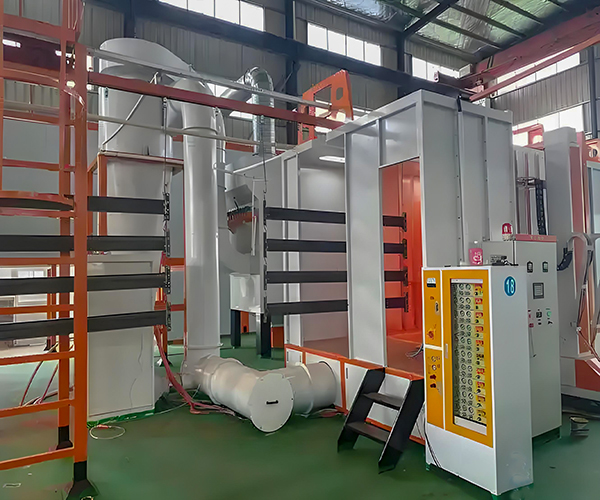
Multi stage water washing: using reverse flow cleaning process, regularly changing the liquid in the washing tank.
4、 Environmental interference related issues
1. Excessive dust concentration
Phenomenon: Dust is flying in the spray booth, affecting the quality of the coating and increasing cleaning costs.
Reason:
Poor sealing of the spray booth or malfunction of the recycling system.
Solution:
Upgrading the cleaning powder room: using smooth inner wall materials and installing a bottom blowing device to reduce powder residue.
Optimization of exhaust system: Regularly clean the exhaust ducts to ensure a wind speed of ≥ 0.5m/s.
2. Temperature and humidity fluctuations
Phenomenon: Poor leveling of the coating or occurrence of pinholes.
Reason:
Air conditioning system failure or inadequate environmental control.
Solution:
Temperature and humidity sensor: Install intelligent monitoring equipment, automatically adjust the air conditioning system, and maintain workshop temperature ≤ 35 ℃ and humidity ≤ 80%.
Dehumidification equipment: Add rotary dehumidifiers during the rainy season to reduce humidity to below 60%.
3. Electromagnetic interference
Phenomenon: Unstable spray gun voltage or control system malfunction.
Reason:
The distance between high-voltage equipment and control system is too close (less than 1 meter).
Solution:
Equipment layout optimization: Separate the high-voltage generator from the control cabinet, with a spacing of ≥ 2 meters.
Electromagnetic shielding: Wrap conductive cloth around high-voltage cables to reduce electromagnetic radiation.
5、 Operational management issues
1. Improper operation by employees
Phenomenon: Excessive coating thickness, missed or repeated spraying.
Reason:
Insufficient training or SOP not implemented.
Solution:
Standardized training: Quarterly operational skills training will be conducted, and those who pass the assessment will be employed.
Visual SOP: Post operation flowcharts in the spraying area, specifying parameter settings such as voltage and chain speed.
2. Inadequate equipment maintenance
Phenomenon: Increased failure rate and shortened equipment lifespan.
Reason:
Lack of maintenance plan or chaotic spare parts management.
Solution:
Preventive maintenance: Develop a monthly maintenance plan, including gun cleaning, chain lubrication, filter replacement, etc.
Digital management: Use CMMS (Computerized Maintenance Management System) to track equipment status and predict faults.
3. Insufficient supply chain collaboration
Phenomenon: Delayed powder supply and unstable quality.
Reason:
Slow supplier response or extensive inventory management.
Solution:
Supplier cooperation: Sign long-term agreements with powder suppliers to customize and develop coatings that are compatible with the manufacturing process.
JIT supply chain: using kanban system to adjust powder inventory in real time according to production plan.
6、 Case verification
1. Chongqing Qianwei Watch Industry
Problem: The efficiency of the spray coating production line is low, and the annual production capacity is insufficient to meet the target value.
Solution:
Upgrade the spraying equipment and curing furnace, and increase the chain speed from 3.0 meters per minute to 3.3 meters per minute.
Optimize the powder formula and use low-temperature solidification powder (120 ℃) to shorten the solidification time by 15%.
Effect: Production efficiency increased by 10%, with an annual output value of over 10 million yuan.
2. A certain household appliance enterprise
Problem: The standard deviation of coating thickness is as high as 8 μ m, and the appearance qualification rate is only 95%.
Solution:
Adjust the spray gun voltage to 60kV and optimize the spraying distance to 180mm.
Introduce AI vision system to monitor coating thickness in real-time.
Effect: The standard deviation of thickness has been reduced to 3 μ m, and the appearance qualification rate has been increased to 99.5%.
3. A certain automotive parts company
Problem: The curing furnace has high energy consumption, with an annual energy cost of over 2 million yuan per line.
Solution:
Install a heat recovery system to use the exhaust waste heat for pre-treatment water washing and heating.
Optimize the design of the curing furnace to reduce heat loss.
Effect: Energy consumption reduced by 18%, saving 360000 yuan in annual costs.
VII. Conclusion
The stable operation of the spray coating assembly line requires comprehensive measures from five aspects: equipment, process, materials, environment, and management. Through preventive maintenance, process parameter optimization, supply chain collaboration, and digital management, the failure rate can be significantly reduced, coating quality can be improved, and production costs can be lowered. In the future, with the application of technologies such as AI algorithm optimization of spraying paths and real-time monitoring of equipment status through the Internet of Things, the spraying assembly line will develop towards a more efficient, intelligent, and green direction.