


Three-dimensional layout: production capacity breakthrough in vertical space
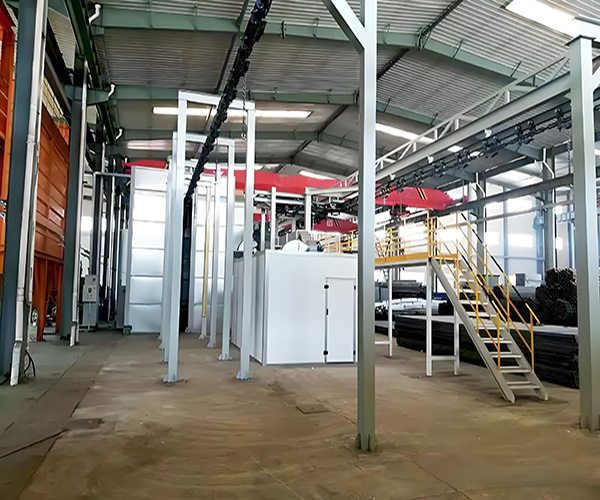
In workshops with limited horizontal space, the vertical dimension becomes the key to improving production capacity. A home appliance parts company adopts a four-layer three-dimensional layout plan: the first layer deploys the spray pre-treatment system, the second layer sets up the powder spraying room, the third layer installs the curing furnace, and the fourth layer is used as the finished product buffer area. The cross-layer flow of workpieces is realized by the spiral elevator, and the unit area production capacity is increased to 3.2 times that of the traditional layout. More cleverly, the spray pump group and the powder recovery system are suspended from the roof truss, which not only releases the ground space, but also shortens the pipeline length by 35% and reduces the pressure loss.
Equipment miniaturization: efficiency revolution of compact design
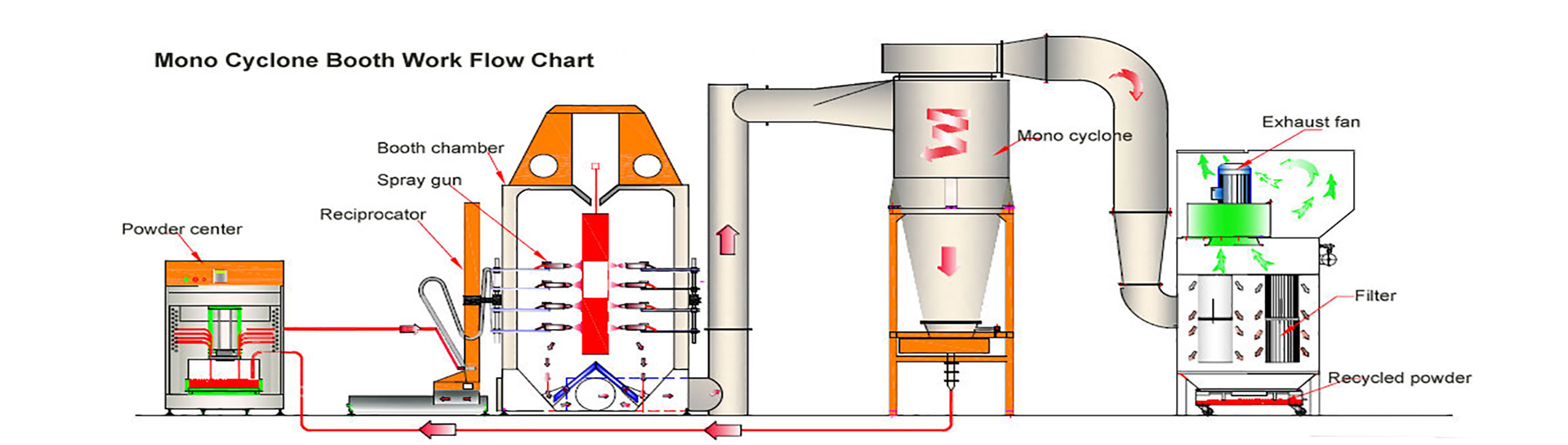
In a limited space, equipment selection directly affects production efficiency. A hardware company uses a mini spray unit with a width of only 0.8 meters, integrating three processes of pre-degreasing, main degreasing, and surface adjustment. By optimizing the nozzle angle and pressure, the line speed is achieved at 2.5 meters/minute. The design of the powder spraying room is more innovative. An automobile parts company has developed a foldable spraying room that meets production needs when unfolded. After contraction, the height is only 1.2 meters, leaving sufficient space for equipment maintenance. The curing furnace adopts a modular design. An agricultural machinery company decomposes the furnace body into 0.6-meter-wide standard units, and customizes the length through building block combination, and the thermal efficiency remains above 92%.
Process innovation: production logic interwoven with time and space
Narrow space needs to break the linear process thinking. A high-end equipment company adopts a U-shaped unit design, connecting the four processes of spraying, powder spraying, curing, and cooling end to end to form a closed-loop production unit, shortening the logistics distance by 75%. What is more worth learning from is the concept of "tidal production line". A home appliance company transformed the curing furnace into a temporary storage area during the off-season, and realized function switching through rapid mold change technology, increasing space utilization by 40%.
Safety and intelligence: double protection of confined space
In terms of safety protection, an automobile parts company adopts a fully enclosed safety guardrail equipped with infrared gratings and safety door locks to ensure that the equipment stops in 0.3 seconds when people enter by mistake. Dust control uses a laminar air supply system to form a 0.3m/s vertical airflow at a height of 4 meters, and the dust concentration in the spray room is stabilized below 1mg/m³. The intelligent management and control system uses laser radar to monitor the position of the workpiece in real time and automatically adjust the trajectory of the robot, so that the overall efficiency of the equipment (OEE) is increased to 92%. Digital twin technology is applied to production commissioning. A company shortened the on-site commissioning cycle by 50% through virtual simulation.
Application scenarios and future trends
This solution is widely used in home appliances, automobiles, hardware and other industries. In the field of home appliances, the cost of spraying the outer shell of refrigerators and washing machines has been reduced by 35%; in the automotive parts industry, the market response speed of products such as wheels and bumpers has increased by 2 times. In the future, with the integration of visual recognition and adaptive control technology, spraying parameters will be optimized in real time, promoting the evolution of coating lines to "high density, high efficiency, and intelligence".