

1. Industry status and energy consumption pain points
Powder spraying technology is widely used in automobile manufacturing, home appliance production and other fields, but the average annual energy consumption of a single spraying line is 500,000-800,000 kWh, of which the curing link accounts for more than 60%, and the powder utilization rate is generally less than 75%. The wiring of traditional decentralized control cabinets is complex and energy-efficient, and the overspray and rebound of manual spraying lead to serious material waste.
2. Multiple optimization paths
①. Equipment upgrade
Centralized electric control cabinet: The centralized electric control cabinet with industrial Internet of Things interface reduces energy consumption by 18% through deep integration, and the spraying qualification rate is increased to 98.7%. The modular design supports 6-12 kinds of powders for fast color change (<5 minutes), which is suitable for the needs of multi-variety production lines.
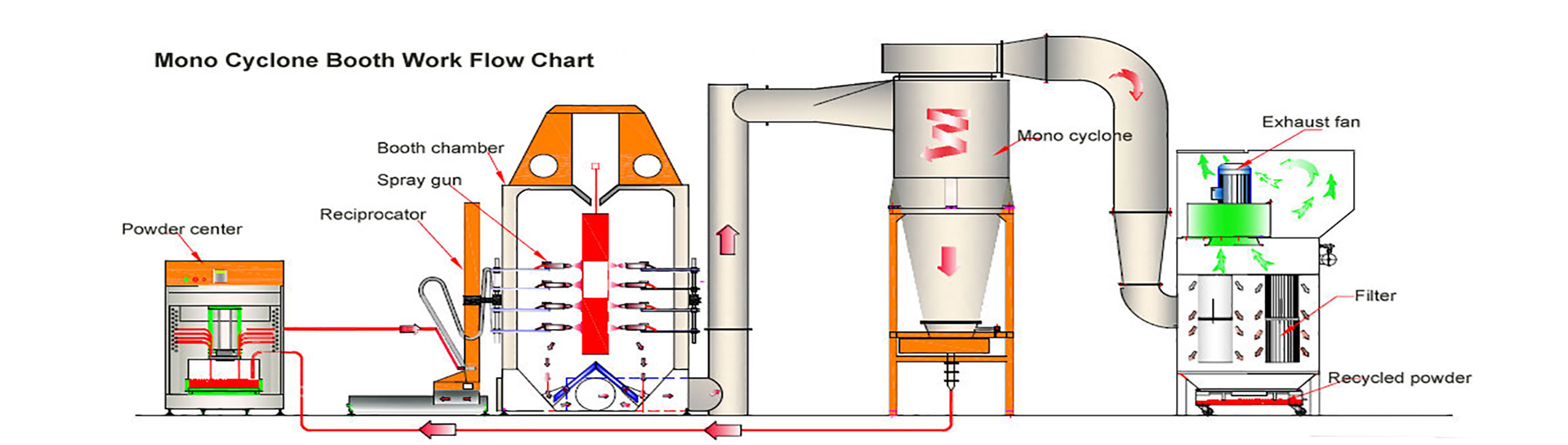
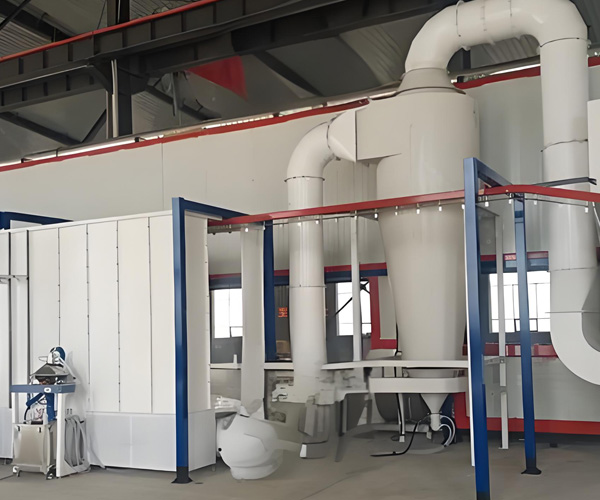
Efficient recovery system: Cyclone separation + pulse filter composite recovery technology increases the powder utilization rate to more than 98%, and the variable frequency fan maintains a slight negative pressure (-15~-20Pa), reducing power consumption by 37%.
②. Process optimization
Intelligent spraying parameters: AI algorithm automatically adjusts the trajectory according to the shape of the workpiece, the electrostatic voltage of metal paint is controlled at 80-90kV, and the solid paint is reduced to 60-70kV, and the atomization pressure is optimized (metal paint 0.35-0.40MPa), so that the powder utilization rate exceeds 92%.
Thermal energy circulation system: Drying exhaust gas passes through RTO incineration + heat exchanger, and the waste heat is used for pre-treatment heating, the thermal energy utilization rate is increased by 40%, and the natural gas consumption is reduced by 25%-30%.
③. Material innovation
High adhesion powder: The recovery rate reaches 99.2%, the qualified rate is increased to 98.5%, and thick film spraying (30μm film thickness) is supported.
Water-based paint replacement: VOC emissions are reduced by 90%, and drying energy consumption is reduced by 35%, which meets the EU CE certification standards.
④. Digital management
IoT energy consumption platform: deploy energy management system, monitor the data of each node in real time, and increase the response speed of abnormal energy consumption by 70%.
Full-link process parameter library: Integrate 12 types of parameters such as ambient temperature and humidity, coating characteristics, dynamically optimize spraying trajectory and baking curve, and improve utilization rate by 18% compared with traditional algorithms.
3. Future trends
AI intelligent control: Real-time monitoring of powder density automatically adjusts airflow, and the recovery rate exceeds 98%.
Low-temperature curing technology: 130℃×5 minutes replaces the traditional 180℃ process, and energy consumption is reduced by another 20%.
Dissolution and crystallization purification: Chemical treatment makes the purity of waste powder comparable to that of new powder, and builds a "zero waste" closed-loop system.
4. Conclusion
The energy efficiency optimization of powder spraying lines requires coordinated efforts in four dimensions: equipment, process, materials, and management. Through the comprehensive application of centralized electric control cabinets, intelligent recycling systems, thermal energy circulation technologies, and digital platforms, enterprises can achieve a 30%-50% reduction in energy consumption, while improving product qualification rates and environmental compliance. Driven by the "dual carbon" goal, the industry is accelerating the transformation from single equipment upgrades to full-link green manufacturing.