


Pre-treatment process: dual considerations of material adaptation and process accuracy
As the cornerstone of the coating process, the selectivity of pre-treatment directly affects the performance of the coating. For workpieces of different materials, enterprises can adopt shot peening or chemical conversion solutions: steel workpieces can simultaneously remove oxide scales and form a rough surface through shot peening to enhance the mechanical anchoring effect of the coating; precision aluminum materials need to adopt a multi-stage phosphating process to improve the anti-corrosion performance through nano-level film conversion. In terms of treatment methods, the selection of automatic spray lines and dipping lines must take into account both efficiency and effect. The multi-station rotary spray pre-treatment unit can achieve high coverage of the workpiece cavity, which is significantly improved compared with traditional processes.
Powder spraying system: synergistic matching of equipment performance and coating characteristics
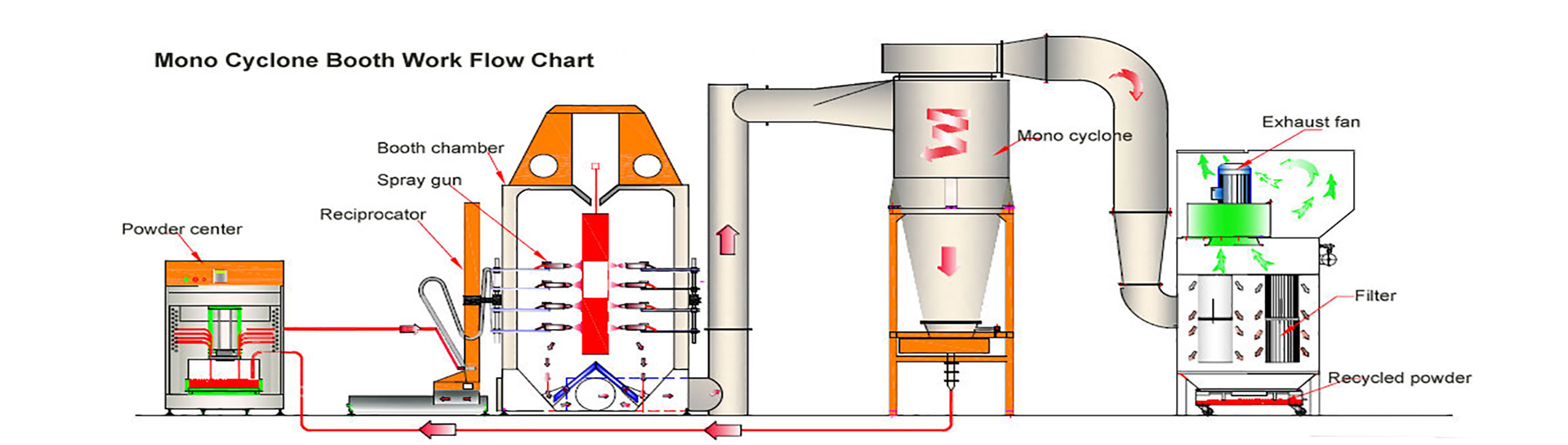
The core of the powder spraying process lies in the coordinated operation of electrostatic adsorption technology and powder recovery system. The mainstream configuration of the industry adopts a large cyclone separation + filter element secondary recovery device to achieve high powder recovery rate and fast color change function. The actual measurement of a home appliance company's production line shows that the recovery system can significantly improve the powder utilization rate and save more than one million yuan in coating costs annually. In terms of process parameter setting, a database needs to be established according to the characteristics of the coating: epoxy/polyester mixed powders need to set specific electrostatic voltage and atomization pressure, while outdoor powders need to adjust the flow rate pressure to ensure the leveling of the coating.
Curing process: the art of balancing thermal energy management and quality control
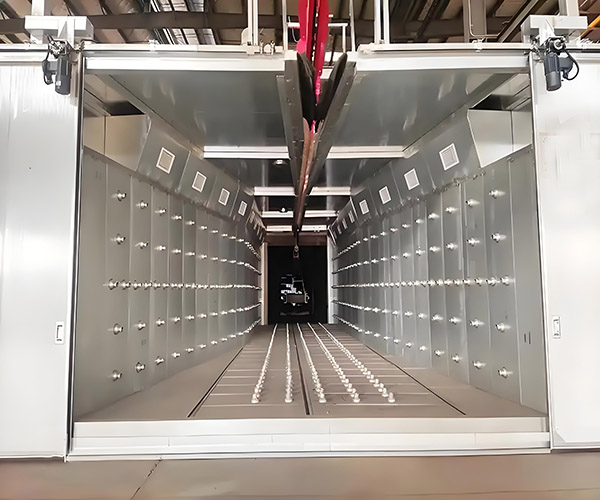
The thermodynamic design of the curing furnace directly affects the physical properties and energy consumption indicators of the coating. The bridge-type hot air circulation curing furnace achieves high paint film hardness performance in the automotive wheel hub spraying line with its temperature control accuracy. A heavy industry enterprise reduces the curing energy consumption by adopting modular heating units, which is significantly more energy-efficient than traditional resistance furnaces. In terms of curing curve setting, a three-dimensional model of temperature-time-workpiece thickness needs to be established: the standard process for steel structural parts can ensure that the coating is fully cured; while thick-walled parts need to adopt a step-by-step heating program to avoid thermal stress causing coating cracking.