


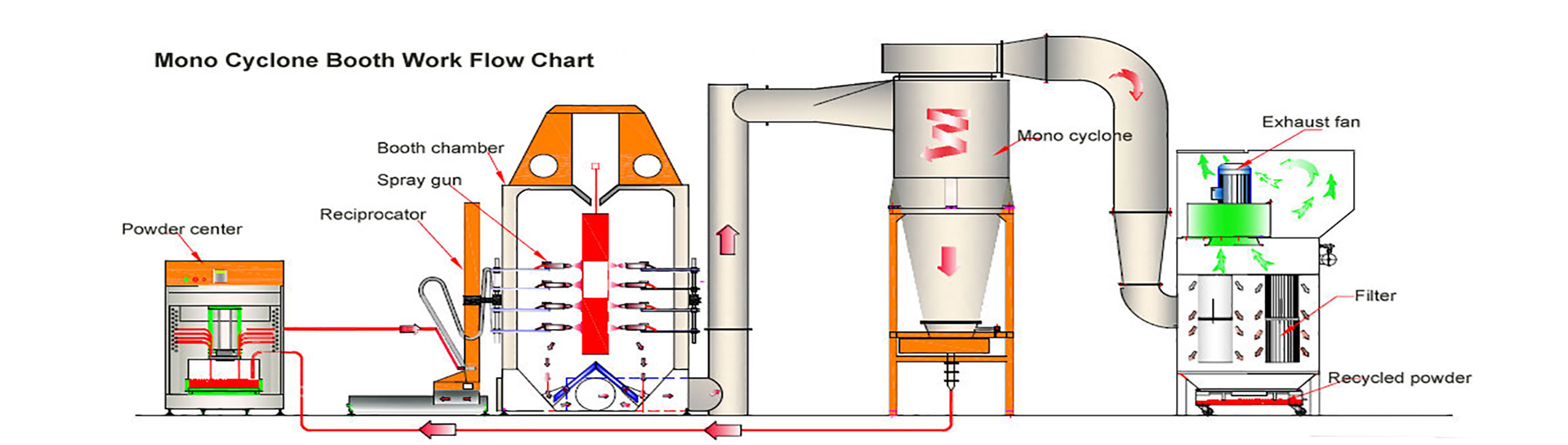
In the field of modern industrial coating, the automated spraying line has become an indispensable production equipment for hardware, home appliances, auto parts and other industries with its high efficiency, precision and environmental protection. This article will deeply analyze the typical process of "automatic spraying line loading → automatic spray cleaning → drying → spraying → curing → unloading inspection" to reveal the technical logic and quality control points behind it.
Automatic spraying line loading: the starting point of precision logistics
The loading link is the prologue of the process flow, and its core lies in achieving accurate positioning and rapid circulation of workpieces. The intelligent loading system adopted by an auto parts company automatically adjusts the workpiece posture through visual recognition technology, and the error is controlled within ±0.5mm to ensure the uniformity of subsequent spraying. What is more noteworthy is that the combined application of AGV trolleys and aerial EMS conveyor lines enables a home appliance company to realize the automation of cross-floor logistics, and the loading efficiency is increased by 40%.
Automatic spray cleaning: the quality cornerstone of surface treatment
Spray cleaning is a key step in determining the adhesion of the coating. The rotary spray cleaning unit used by a hardware product company uses a 360° rotating nozzle to achieve an inner cavity coverage rate of 98%, which is 23 percentage points higher than the traditional hanging line. The parameter control of the cleaning fluid is an art: the concentration of the alkaline cleaning agent must be accurately maintained at 3.5±0.2%, and the pH value is stabilized at 10.5 through the automatic feeding system to ensure that the oil on the surface of the workpiece is completely removed. A more cutting-edge practice is that a high-end equipment manufacturing company introduced ultrasonic cleaning technology to achieve a cleanliness of 99.9% for tiny pores, laying a perfect foundation for subsequent spraying.
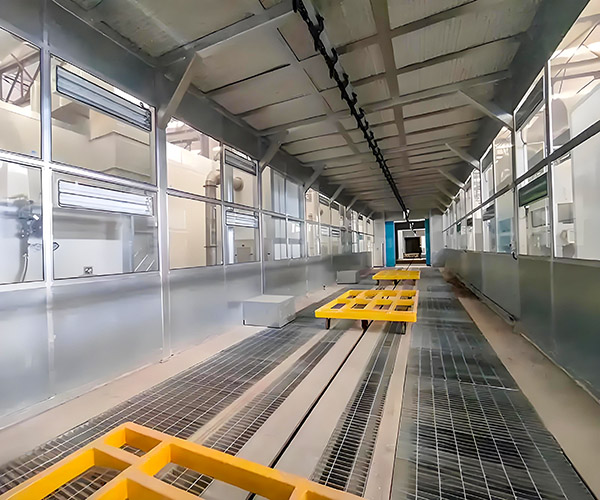
Drying process: precise balance of moisture control
The drying process requires precise control of temperature and time to avoid deformation or oxidation of the workpiece. The bridge-type hot air circulation drying furnace used by an agricultural machinery company achieves a temperature control accuracy of ±3℃ through CFD simulation optimization to ensure that the moisture on the surface of the workpiece is completely evaporated. More noteworthy is that the application of infrared radiation drying technology has enabled a home appliance company to achieve rapid startup and energy-saving operation, shortening the drying time to 1/3 of the traditional method and reducing energy consumption by 25%.
Multi-layer spraying: customized solutions for special needs
Multi-layer spraying is used for special materials or workpieces with high anti-corrosion requirements, and performance is superimposed through multi-layer spraying. A heavy industry enterprise adopts the "epoxy primer + polyurethane topcoat" solution to make the salt spray resistance of engineering machinery covers reach more than 2,000 hours. More precise control lies in the fact that digital twin technology has been applied to spray trajectory planning. The system automatically generates the optimal path based on the three-dimensional model of the workpiece, which increases the paint transfer efficiency to 82%.
Curing process: the ultimate quenching of coating performance
The curing furnace is the "alchemy furnace" of coating performance. An automotive parts company uses modular heating units to reduce energy consumption to 0.15kW·h/kg, which is 37% energy-saving compared to traditional resistance furnaces. The curing curve setting is scientific: steel structures below 5mm use a standard process of 180℃×20 minutes, while thick-walled parts above 10mm need to apply a step-by-step heating program to avoid thermal stress causing coating cracking. The infrared thermal imaging system monitors the temperature field of the workpiece in real time, so that the curing uniformity reaches more than 98%.
Next-piece inspection: the final chapter of quality control
Next-piece inspection is a closed-loop link in the process. The intelligent detection system deployed by a home appliance company monitors the coating thickness, glossiness and color difference in real time through hyperspectral imaging technology, and the data is automatically uploaded to the MES system. What is more noteworthy is that AI visual inspection has achieved automatic classification and rating of defects, reducing the missed detection rate of a hardware product company to below 0.3% and the customer complaint rate to 65%.
Future trend: dual evolution of intelligence and green
With the advancement of Industry 4.0, automated spraying lines are showing new features: pre-treatment agents are evolving towards phosphorus-free/low-zinc formulas, powder spraying systems are deeply integrated with digital twin technology, and heat recovery technology is widely used in curing processes. For manufacturing companies, choosing an automated spraying line is not only about purchasing equipment, but also about building a data-driven intelligent coating platform, which will become the key support for companies to create high-quality, low-cost, and green production systems. On this production line, every flow of workpieces and every degree of temperature control are interpreting the precision and wisdom of modern manufacturing.