


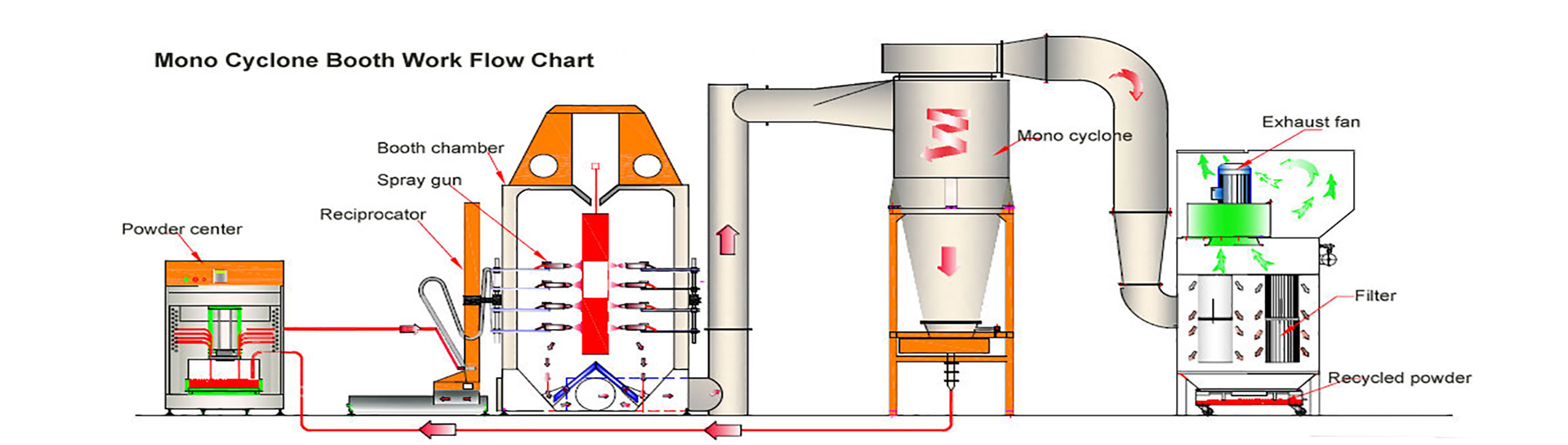
Driven by both green manufacturing and personalized demand, electrostatic powder coating technology has emerged as a key technological innovation direction in the furniture manufacturing sector due to its unique process characteristics. This technology utilizes a high-voltage electrostatic field to uniformly adsorb powder coatings onto the surface of workpieces, which are then cured at high temperatures to form a dense coating. The entire process is solvent-free, ensuring environmental friendliness from production to use, aligning with modern industry's demands for low-carbon and sustainable development.
Technical characteristics drive process innovation
The "global adsorption" capability of electrostatic powder coating breaks through the limitations of traditional painting on complex shapes. Whether it is carved hollow structures, curved lines, or three-dimensional irregular parts, the powder can achieve uniform coverage without dead zones, avoiding common issues such as sagging, accumulation, or uneven coating on edges and corners found in traditional processes. The coating formed by its "dry film formation" characteristic possesses high compactness and weather resistance, maintaining color stability and surface integrity even after long-term use. At the same time, it exhibits excellent scratch resistance and chemical corrosion resistance, extending the service life of furniture.
The value realization of multi-scenario applications
In the field of metal furniture, electrostatic powder coating provides a wear-resistant and scratch-resistant protective layer for office desks, storage cabinets, etc. The coating exhibits excellent weather resistance and is suitable for long-term use in outdoor public facilities. In terms of wooden furniture, this technology achieves seamless spraying on all six sides of door panels and cabinets. The sealed coating effectively blocks moisture penetration and enhances moisture resistance, making it particularly suitable for wet environments such as kitchens and bathrooms. For curved components and irregular structural parts of children's furniture, an automatic spray gun coupled with an intelligent conveyor system can achieve millimeter-level precision control, ensuring uniform and fine coating to meet the dual requirements of safety and aesthetics.
Synergistic benefits of ecology and economy
In the production process, the high utilization rate of powder coatings, combined with a recycling system, significantly reduces material consumption and waste generation. The entire process is environmentally friendly, with no wastewater or exhaust emissions, helping enterprises achieve clean production and meeting green supply chain certification standards. In terms of economy, automated spraying lines improve operational efficiency through precise parameter control, providing greater stability and efficiency compared to traditional processes. At the same time, they reduce quality fluctuations caused by human intervention, enhancing overall production efficiency.
Future trends and directions of technology integration
With the development of intelligent manufacturing, electrostatic powder coating equipment is deeply integrating with AI vision systems and the industrial Internet, enabling intelligent planning and remote control of spraying paths and enhancing process flexibility. In terms of material innovation, the research and development of functional powders, such as antibacterial and self-healing coatings, will expand applications in niche scenarios such as medical furniture and outdoor furniture. In terms of industrial ecology, this technology is driving the transformation of furniture manufacturing towards a flexible production model of "modular design + intelligent coating". By implementing standardized interfaces for rapid line changeover, it meets the customized needs of small batches and multiple varieties, becoming the core support for building a green intelligent manufacturing system.
The electrostatic powder coating process, with its technological maturity and environmental compliance, is becoming a key choice for furniture enterprises to achieve differentiated competition and fulfill social responsibility. In the current era of intensified homogenization competition in customized home furnishing, this technology will lead the industry towards an evolution towards "zero pollution, high precision, and personalization", bringing safer and more durable home furnishing products to consumers, while promoting green and coordinated development of the upstream and downstream of the industrial chain, and building a sustainable industrial ecosystem.