


As the core process equipment in the hardware processing industry, the spray painting assembly line has achieved a transformation and upgrading from "traditional manual spraying" to "efficient and green production" through the integration of automation, intelligence, and environmental protection technology. Its application not only improves production efficiency and product quality, but also promotes the sustainable development of the industry. The following in-depth analysis will be conducted from four dimensions: process flow, technological advantages, application cases, and future trends.
1、 Refined design of process flow
The process flow of the spray painting assembly line covers four core links: pre-treatment, spraying, drying and curing, and post-treatment. Each link adopts standardized and automated operations to ensure stable quality.
Pre treatment: Through automated spraying or soaking systems, oil removal, rust removal, phosphating and other processes are completed to form a dense conversion film to enhance coating adhesion. For example, in metal processing, phosphating treatment can improve the corrosion resistance of coatings and extend the service life of products.
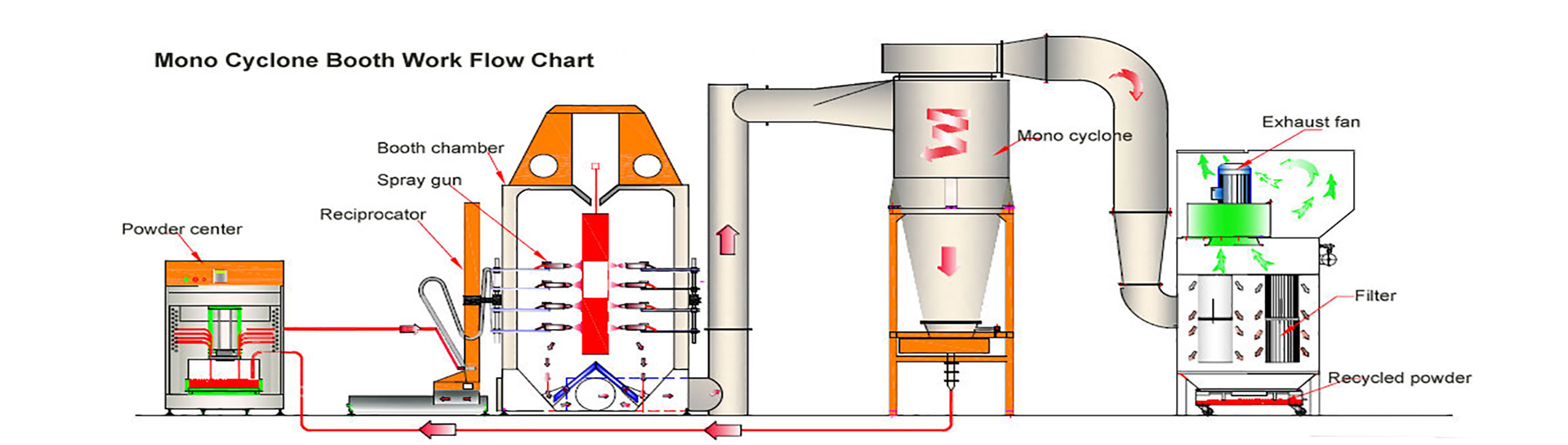
Spraying process: Multi axis industrial robots or reciprocating automatic spray guns are used to control the spraying pressure, speed, and distance through preset programs, achieving uniform coating thickness and complete edge coverage. The electrostatic spraying technology can increase the utilization rate to over 95% and significantly reduce material waste by adsorbing coatings with electrostatic force.
Drying and curing: Using hot air circulation or infrared radiation heating, precisely control the temperature (60-120 ℃) and time to ensure that the coating is fully cured. The application of clean energy such as natural gas reduces the pressure of waste gas treatment and meets environmental protection requirements.
Post processing: Automatically identify coating defects (such as sagging and bubbles) through a visual inspection system, and cooperate with manual re inspection to ensure the quality of the finished product. The data recording system can trace process parameters and support quality optimization and problem tracing.
2、 Comprehensive manifestation of technological advantages
The core advantages of the spray painting assembly line are reflected in four aspects: efficiency improvement, stable quality, cost control, and environmental compliance.
Efficiency improvement: The continuous production mode reduces manual intervention and increases daily processing capacity by 3-5 times compared to manual spraying. For example, the production line of automotive parts can increase efficiency by more than 50% and shorten the changeover time to within 10 minutes through robot spraying.
Stable quality: Automated control eliminates human factors, coating thickness errors are controlled within a very small range, and the product qualification rate is significantly improved. In the spraying of complex curved workpieces, offline programming technology can optimize the spray gun path, avoid interference, and ensure uniform coverage.
Cost control: Improved coating utilization rate (such as powder recycling system achieving a utilization rate of 98%), reduced energy consumption (such as infrared curing reducing energy consumption by 20%), reduced labor costs, and significantly reduced long-term operating costs.
Environmental compliance: Water curtains or dry filtration systems capture paint mist, VOCs treatment devices (such as activated carbon adsorption and catalytic combustion) reduce emissions, wastewater recycling reduces water resource consumption, and meets international environmental standards.
3、 Typical cases of industry applications
Automotive parts manufacturing: The electrostatic spraying assembly line achieves high-precision spraying, ensuring consistency in body color and weather resistance of coatings, while reducing VOCs emissions through exhaust gas treatment systems.
Home appliance shell processing: Automatic spraying equipment ensures uniform and beautiful coating, enhances product appearance competitiveness, and adapts to multi model production needs through modular design.
Architectural hardware treatment: Environmentally friendly spray painting lines are used for doors, windows, aluminum profiles, etc., reducing environmental impact and improving coating durability through water-based coatings and closed-loop recycling systems.
Corrosion prevention of metal parts: The integrated design of pre-treatment and spraying enhances the corrosion resistance of metal parts, extends their service life, and reduces maintenance costs in the later stage.
4、 Innovative Trends for Future Development
With the advancement of Industry 4.0 and green manufacturing, spray painting assembly lines are developing towards intelligence, modularity, and greenness.
Intelligent upgrade: Introducing AI algorithms to achieve autonomous optimization of spraying parameters, combined with real-time monitoring of process status by sensors, dynamically adjusting parameters to adapt to different workpiece requirements.
Modular design: Quick change fixtures and programmable conveyor systems support multi variety and small batch production, improving equipment utilization and production efficiency.
Green environmental protection technology: The application of water-based coatings, powder recycling systems, and thermal energy recovery technology further reduces energy consumption and emissions, promoting a circular economy.
Digital management: Integrated production data platform to achieve visual monitoring and analysis of process parameters, energy consumption, and quality indicators, supporting lean production and continuous improvement.