


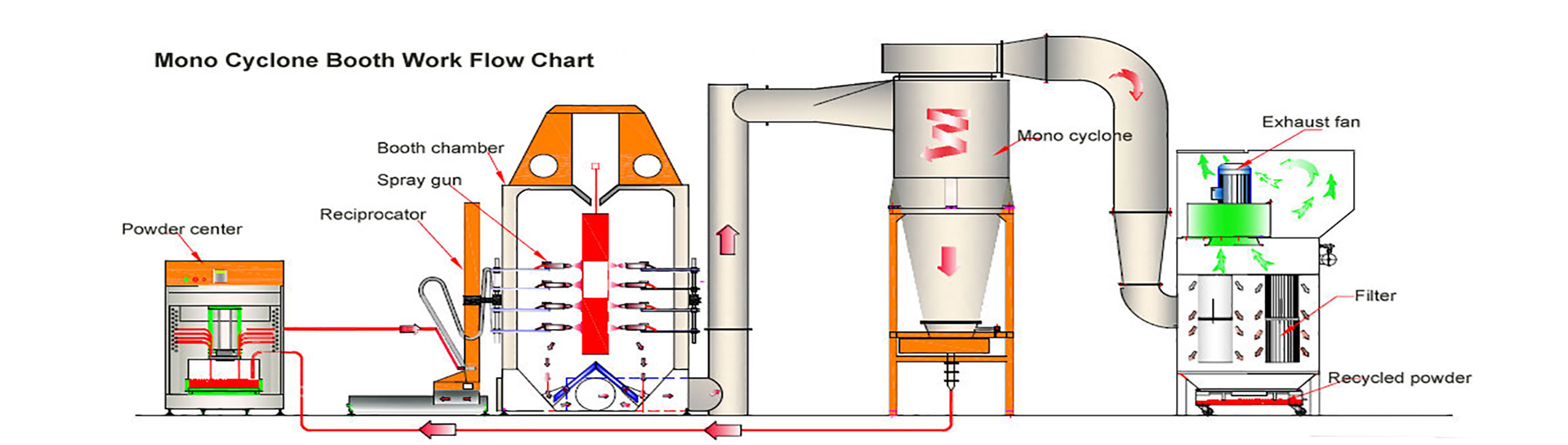
In the wave of industrial automation upgrading, the conveyor equipment of the assembly line has become the core support system of the spray painting assembly line. It achieves a comprehensive breakthrough in production efficiency, quality stability, and cost-effectiveness through the three in one technology of "dynamic accumulation precise conveying intelligent control". The specific necessity is reflected in the following dimensions:
Efficiency leap: Refactoring production rhythm logic
The stacking line conveying equipment adopts zero pressure stacking technology, and achieves intelligent scheduling of workpieces through PLC+HMI control system and sensor network. In the automotive parts painting line, the daily production of a single line can be increased from the traditional mode of 800 pieces to 1200 pieces, with a 50% increase in efficiency. Its modular track system supports multi-dimensional layout of horizontal/vertical/climbing (≤ 15 °), and with the T-shaped groove quick installation interface of 6063-T5 aluminum alloy track, it can flexibly adapt to different production line spaces. For example, in the Gree air conditioning intelligent testing line, 200 internal units are stored in a 15 meter buffer zone to achieve precise matching with the testing rhythm of external units, and the changeover time is compressed to 0 seconds.
Quality Assurance: Process Stability Guarantee
The equipment achieves instantaneous switching between "power transmission free sliding" through a double hinged chain and friction wheel structure, ensuring that the workpiece is transported without physical compression. In the Toyota TNGA platform mixed flow assembly line, the stacking line supports 50+vehicle models to accumulate simultaneously, and the vehicle ID recognition system automatically switches the assembly program. The paint coating uniformity error is controlled within ± 0.1mm. Combined with a dual composite positioning system of laser ranging sensor and RFID reader, the positioning accuracy reaches ± 1mm, effectively avoiding coating defects caused by manual handling, and the product qualification rate is increased to 99.2%.
Cost optimization: full lifecycle value mining
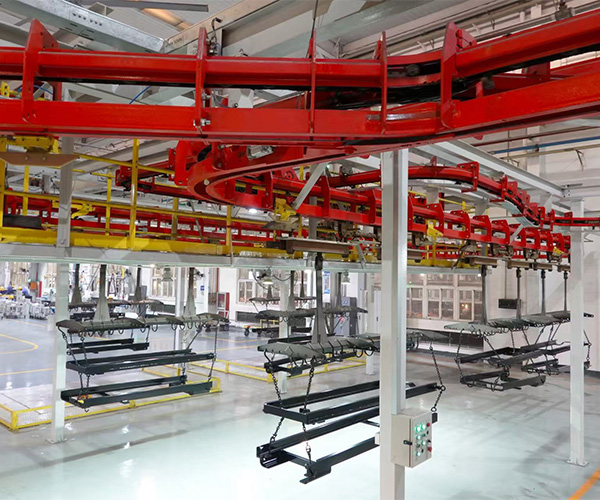
The device adopts a modular design and a plug and play standard component library, which shortens the project delivery cycle by an average of 23 days. In the Dali Garden bread production line, the 304 stainless steel material stacking line has passed HACCP certification, achieving temperature and humidity balance control in the cooling section to store products and reduce rework costs. In terms of energy consumption, the distributed drive unit is equipped with a 2.2kW variable frequency motor every 10 meters, which saves 35% energy compared to the traditional continuous operation mode. A new energy battery factory has measured an annual electricity cost savings of over one million yuan.
Environmental Collaboration: A New Paradigm for Green Production
Deep collaboration between stacking lines and environmental protection equipment to build a closed-loop ecosystem. At the sorting center of JD Asia's No.1 warehouse, the peak processing capacity of the stacking line is 200000 pieces per day, with a sorting accuracy rate of 99.99%. The dynamic adjustment of package spacing improves the efficiency of the sorting robot. It is linked with catalytic combustion equipment to achieve efficient degradation of VOCs in paint exhaust gas treatment, reducing the emission concentration from 300mg/m ³ before the renovation to below 20mg/m ³, in compliance with the "Emission Standards for Air Pollutants in the Shipbuilding Industry".
Future trend: Intelligent integration drives industrial upgrading
With the advancement of Industry 4.0, Jifang Line is moving towards a new stage of intelligent integration of "perception decision execution". The AI diagnostic system achieves 90% fault self-healing, and the digital twin module can simulate 200 abnormal working conditions, improving system resilience. In flexible production lines, AGV and stacking line are virtually debugged through a digital twin system, reducing trial and error costs by 60%. The application of 5G+industrial Internet technology enables the real-time connection of equipment operation data to the MES/WMS system, achieving an increase in production energy efficiency of more than 15%.