


1. Clarify the core needs: output, vehicle model and budget
Before selecting equipment, you need to accurately locate the production scenario:
Production scale: semi-automatic lines can be selected for less than 500 units per day, and fully automated configuration is required for more than 1,000 units.
Vehicle adaptation: The difference between SUV and sedan leads to different spraying trajectories, and it is necessary to confirm whether the equipment supports 3D scanning modeling.
Budget allocation: The initial investment is recommended to account for 40%-60% of the total project funds, leaving room for upgrades.
2. Selection of key equipment technology
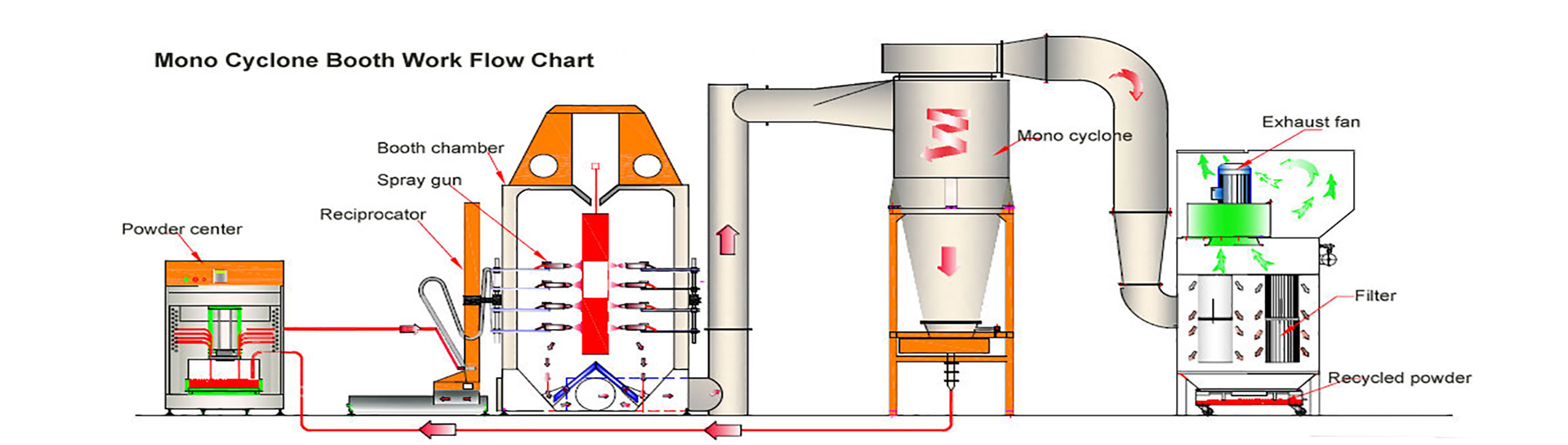
2.1 Spraying system
Robot arm selection: Six-axis robots are suitable for complex surfaces (such as engine hoods), and four-axis robots are more efficient but less flexible.
Spray gun technology: Electrostatic rotary cup spray guns can reduce paint consumption by 30%, but they need to be equipped with a dedicated high-voltage power supply.
Paint supply system: The accuracy of the two-component mixing ratio pump must reach ±1% to avoid color difference problems.
2.2 Drying equipment
Infrared + hot air combination: short-wave infrared preheating (120℃) + hot air circulation (180℃) can shorten the drying time to 15 minutes.
UV curing adaptation: Water-based UV coatings need to be equipped with nitrogen protection devices to prevent oxidation.
2.3 Environmental protection facilities
Waste gas treatment: The combined treatment efficiency of zeolite rotor + RTO incineration is 98%, which meets the EU BAT standard.
Wastewater circulation: The three-stage sedimentation + membrane filtration system can achieve 85% reuse of reclaimed water.
III. Intelligence and data integration
3.1 Internet of Things architecture
The equipment interconnection adopts the OPC UA protocol to realize the real-time upload of spraying parameters to the MES system.
The energy monitoring module can identify 15% of power waste points.
3.2 Digital twin technology
The virtual commissioning platform can simulate the operation of the production line in advance and reduce the on-site commissioning time by 40%.
The AI visual system automatically identifies 20 common defects with a false detection rate of <0.5%.
IV. International compliance verification
4.1 Core certification
EU CE certification (mechanical safety) + EMC certification (electromagnetic compatibility).
US UL 1389 standard (fire protection of spray booths).
China GB 24409-2020 (Limits of Hazardous Substances in Passenger Car Paints).
4.2 Regional Adaptation
The Southeast Asian market needs to consider the configuration of dehumidification systems in high humidity environments.
Russia's extremely cold regions need to add constant temperature paint delivery devices.
V. Supplier Evaluation Dimensions
5.1 Technical Strength
Whether there is self-developed spraying simulation software (such as a virtual debugging platform).
Number of Patents: Focus on spraying trajectory optimization and paint recycling.
5.2 Delivery Capability
Typical project cycle: 6-8 months for standard lines and 10-12 months for customized lines.
Spare parts inventory: The localization rate of key components (such as servo motors) must reach 70%.
5.3 After-sales Service
Remote diagnosis coverage: Core equipment should support 5G remote debugging.
Training system: Whether operator certification courses are provided.
VI. Future Upgrade Path
6.1 Material Innovation
Low-temperature curing powder coatings (curing at 120°C) gradually replace liquid paints.
Graphene-modified coatings improve anti-corrosion performance.
6.2 Process iteration
Dry spray booth technology (filtration efficiency 99.5%) reduces water treatment costs.
3D printing fixtures enable fast changeover (<10 minutes).
Conclusion
The selection of automotive spray painting equipment is a triangular balance of technology, cost and compliance. Export-oriented enterprises need to establish a "equipment-process-standard" three-in-one evaluation system and give priority to suppliers that provide full life cycle services. With the popularization of digital twins and AI quality inspection, early layout of intelligence will gain long-term competitive advantages.