


In the competitive world of manufacturing, a flawless coatings finish can make or break customer satisfaction. Yet, debris, dust, or particles trapped under paint remain a top challenge for coating lines. These defects not only ruin aesthetics but also compromise corrosion resistance. Here’s how to eliminate them at every stage of your painting equipment production line.
1. Pre-Treatment Perfection: The Foundation of Cleanliness
Degreasing Dilemmas: Oil residues from stamping or machining attract airborne dust. Use alkaline cleaners and maintain water pH at 10–12 for optimal degreasing.
Rust Prevention: Iron filings from welding stations contaminate lines. Install magnetic separators pre-treatment tanks.
Drying Efficiency: Water spots invite debris. Ensure oven temperatures reach 120–150°C for 15-minute drying cycles.
Pro Tip: Test with a contact angle meter—water droplets forming <90° angles indicate clean surfaces.
2. Paint Booth Control: Where Science Meets Sanitation
Air Quality: A single dust particle per cubic meter ruins finishes. Use HEPA filters (99.97% efficiency) and maintain positive booth pressure.
Static Elimination: Ionizing bars reduce particle adhesion. Position them 30cm from conveyors.
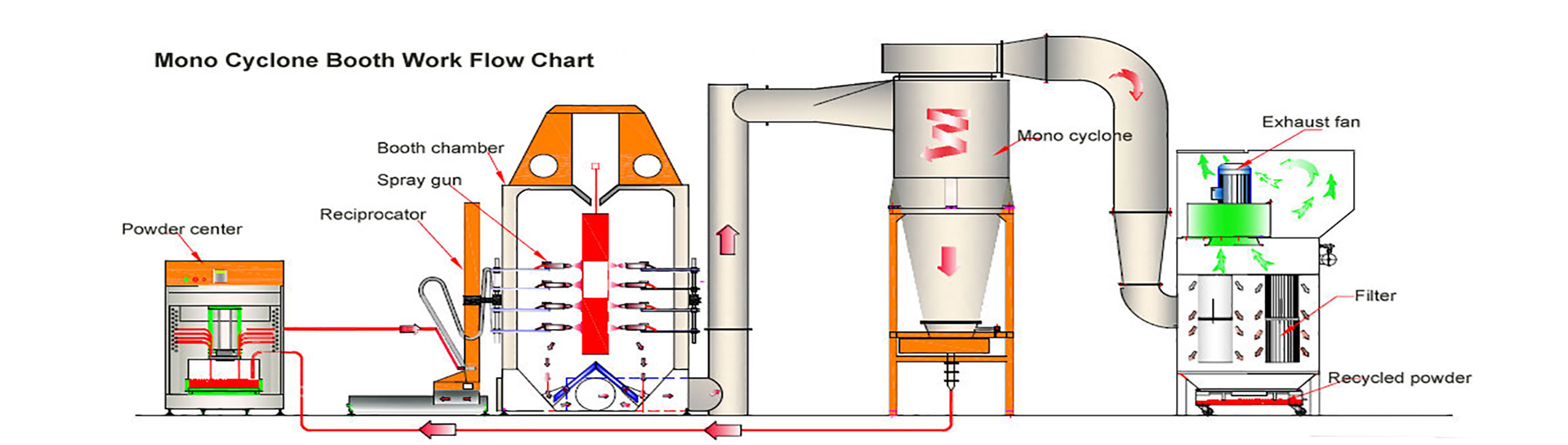
Overspray Management: Cross-draft booths trap 95% of overspray. Clean filters weekly to prevent blowback.
Case Study: An Indian appliance maker reduced defects by 60% after upgrading to a downdraft booth with pulse-jet filter cleaning.
3. Material Management: From Purity to Application
Powder Storage: Humidity >60% clumps powder. Store at 25°C/50% RH in sealed containers.
Gun Maintenance: Worn nozzle inserts create uneven patterns. Replace every 500 hours or when flow drops 10%.
Grounding Checks: Poor electrical contact causes static. Verify with a multimeter (target <1 MΩ resistance).
Data Insight: 82% of coating defects trace back to improper gun maintenance or material handling.
4. Curing Precision: The Final Frontier
Temperature Zones: Fluctuations >±5°C create orange peel. Use infrared pyrometers for real-time oven mapping.
Conveyor Speed: Variations as small as 0.1 m/min affect cure time. Install encoder-driven controls.
Cooling Stations: Rapid cooling traps moisture. Gradually reduce temperatures to ≤80°C before packaging.
Legal Compliance: AATCC test methods ensure curing meets automotive/aerospace standards.