


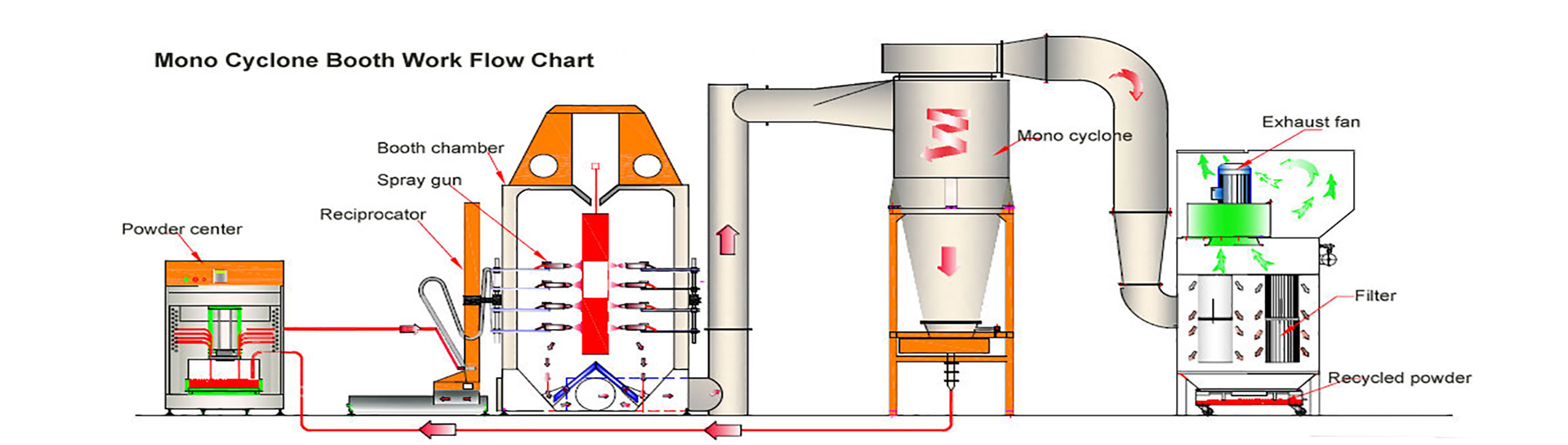
In modern industrial production, the paint spraying line and its supporting exhaust gas treatment equipment together constitute the core unit of the surface treatment process. These two components not only fulfill the basic functions of product decoration and protection but also play an irreplaceable role in environmental compliance, production safety, and sustainable development. Through technological synergy and process optimization, they promote a three-dimensional balance of quality, efficiency, and environmental protection in industrial production, serving as a key support for the transition to green manufacturing. The following elaborates on their synergistic effects and value from five dimensions.
1. Basic functions and industrial value of the painting line
The painting line plays a pivotal role in industrial production, specifically in surface treatment and protection. For instance, in automobile manufacturing, multiple painting processes are employed to apply a corrosion-resistant and scratch-resistant coating to the vehicle body, while simultaneously enhancing the aesthetic appearance of the product. In the furniture industry, ultraviolet curing technology is utilized to facilitate rapid drying of coatings, thereby boosting production efficiency. The widespread adoption of electrostatic spraying technology has significantly increased paint utilization, reduced raw material wastage, and underscored the irreplaceable role of the painting line in fundamental processes.
II. The Necessity and Technical Logic of Exhaust Gas Treatment
The exhaust gas generated during painting operations contains pollutants such as volatile organic compounds (VOCs) and paint mist particles, which, if directly discharged, will harm the environment and workers' health. The exhaust gas treatment equipment adopts a three-stage treatment mode of "filtration-adsorption-decomposition": a dry filter intercepts paint mist particles, an activated carbon adsorption tower concentrates VOCs, and a catalytic combustion device converts harmful substances into harmless carbon dioxide and water, ensuring that emissions meet standards and comply with environmental regulations.
III. Practical benefits of bidirectional collaboration
The coordinated operation of the painting line and exhaust gas treatment equipment brings multiple practical benefits. In terms of process optimization, intelligent spraying parameter regulation improves coating uniformity and reduces rework. In terms of environmental protection, the exhaust gas treatment equipment reduces the emission intensity of pollutants, and when combined with the use of low VOCs coatings, it reduces pollution at the source. In terms of safety, it effectively controls the concentration of harmful substances in the workplace, safeguards workers' health, and promotes the balanced development of industrial production towards quality, efficiency, and environmental protection.
IV. Core directions of technological evolution
With technological advancements, the painting line is evolving towards intelligence, utilizing sensors to monitor the coating status in real-time and enabling dynamic adjustment of spraying parameters. Exhaust gas treatment equipment incorporates novel adsorbent materials and efficient combustion technologies, enhancing treatment efficiency and energy consumption ratio. The promotion and use of low VOCs coatings, coupled with collaborative equipment optimization, further propel the transition of industrial production towards a green and low-carbon future.
V. Green Trends in Future Development
Industrial production is moving towards a closed-loop model of "production-treatment-regeneration". Digital twin technology simulates the treatment effects under different working conditions and optimizes equipment operating parameters. The application of carbon capture technology has driven the development of waste gas treatment towards "near-zero emissions". By capturing carbon dioxide with adsorbent materials and converting it into industrial raw materials, carbon recycling is achieved. This trend reflects the inevitable direction of the integrated development of industrial civilization and ecological civilization, providing solid technical support for sustainable development.